
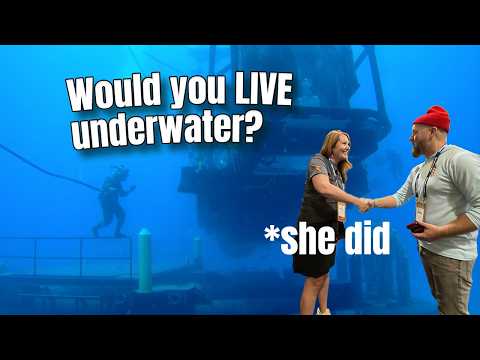
The closest experience you or I will ever get to living on another planet probably won’t be space, but down in the ocean.
Special thanks to @DeepEngineered for connecting us, and providing the epic footage seen in this video!
In this interview, I’m joined by Dr. Dawn Kernagis:
Scientist, explorer, freediver, cave diver, and aquanaut who was selected for NASA’s NEEMO 21 mission. For sixteen days, Dawn lived and worked inside Aquarius Reef Base, an underwater habitat off the Florida Keys used by NASA to study how people perform in an isolated, extreme environment kinda like astronauts preparing for missions beyond Earth.
Dawn gives us a rare, firsthand look at what daily life inside an underwater habitat is really like: working, diving, conducting research, living in close quarters, and the advantages of being able to do research without having to keep coming up for air or decompressing.
Beyond what it’s like to live underwater, you’re gonna get a ridiculous first look at DEEP’s Vanguard habitat—a new generation of subsea technology designed to expand what scientists and future aquanauts can accomplish beneath the ocean.
This is where space exploration, marine science, human performance, and the future of underwater habitation all converge.
So, what does it actually feel like to live underwater and have the ocean floor as your front yard?
I got to have a real conversation with Dr. Kernagis her at Atlantic City’s first ever Scuba Show this year.
NOTE: The video footage of the habitat is actually DEEP’s new Vanguard habitat being prepped and sank in the Florida Keys. This will hopefully be where another follow up interview takes place! 🤞
Quick facts on the underwater habitat shown in this video:
• Habitat: Vanguard.
• Organization: DEEP.
• Location: Tennessee Reef, Florida Keys National Marine Sanctuary.
• Features: Dive center with moon pool entry/exit for scuba, rebreather, and hard-hat diving,
reconfigurable living chamber with bunks for four and communal lounge area, safety refuges,
emergency power, and breathing gas.
• Supporting infrastructure: Shore-based command center, watch desk, decompression chamber,
mission support vessels, and facilities for habitat diver training.
• Inhabitants: Crews of up to four aquanauts, living and working underwater for five+ days at a time.
• Mission types: Marine science research, coral reef restoration, long-term monitoring, climate impact
studies, human performance research, and training for extreme environments.
• Total installation weight of foundation, ballast, and habitat: 465 tons.
• Structure footprint (including foundation): 14 meters (46 ft) x 12 meters (39 ft).
• Livable area of the habitat: 10.7 meters (35 ft) long x 2.5 meters (8 ft) wide.
• Ocean floor installation depth: 17 meters (56 ft).
• Habitat living pressure depth: 13 meters (43 ft).
• Partners: DEEP’s partners on the Vanguard project include Unique Group, Bastion Technologies, Triton Submarines, and Resolve Marine.
On its mission to make humans aquatic, ocean engineering firm, DEEP, is developing subsea habitats, systems, and training to enable a continuous human presence in the ocean. Vanguard, its prototype habitat, is the first step in a long-term infrastructure program.
Next comes Sentinel – a modular habitat system designed for scale.
Special thanks to Deep Research Labs Limited.
www.deep.com
Kenny Dyal is the host of the Scuba Diving Channel
www.sweetwaterscuba.com
