
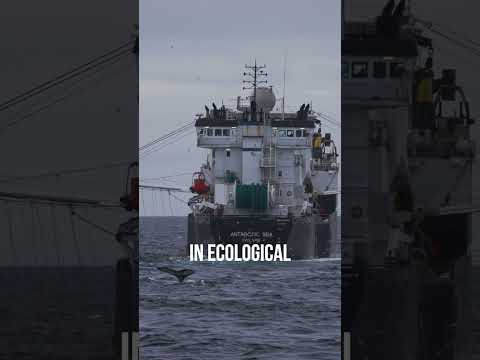
🚨 Once again, the Antarctic krill fishing fleet has reached its 620,000 tonne trigger catch level.
Last year, the industry reached this level for the first time in history, forcing the fishery to close months early.
Now, it has happened for the second year in a row.
Until the end of 2024, conservation rules limited how much krill could be taken from individual areas around the Antarctic Peninsula.
But CCAMLR countries failed to renew them. Without these safeguards, industrial supertrawlers have been allowed to concentrate their fishing in ecological hotspots where krill gather and where whales, penguins and seals come to feed.
In both seasons since those safeguards expired, the fleet has reached the overall trigger level early, intensifying pressure on some of Antarctica’s most important wildlife feeding grounds.
Yet instead of supporting the stronger protections Antarctica urgently needs, the krill fishing industry is pushing to increase the permitted catch to as much as 1.1 million tonnes, almost twice the current trigger level.
Krill sustains the entire Antarctic ecosystem. Whales, penguins, seals and countless other species depend on it. Krill also helps the ocean store carbon.
🗣️ Reaching the trigger level early for a second year is not a warning. It is evidence of an industry accelerating its plunder of Antarctica. 🚨
Antarctica does not need more industrial krill fishing.
It needs stronger protection from it. ✊🌊
🔗 Read the full commentary by Peter Hammarstedt, Director of Campaigns at Sea Shepherd Global: https://seashe.ph/krill-fishery-closes-early-again
#StopThePlunder #ProtectAntarctica #Krill #SeaShepherd
