
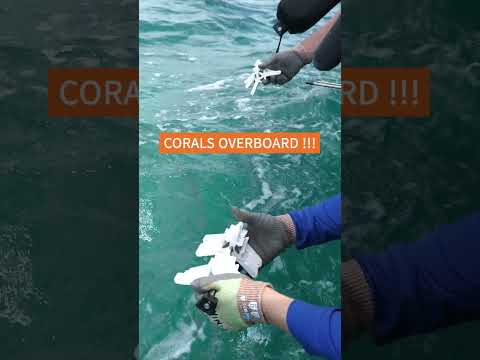
Our baby corals have reached the end of their journey to the Great Barrier Reef 🪸🙌
By road and by sea, they travelled from AIMS The National Sea Simulator (SeaSim) and the facilities of our industry partners to carefully selected locations in the northern and southern regions of the Reef.
This marks the culmination of three months of coral care and innovation since this season’s spawning began: first with their parents being collected from the Reef, onto long spawning nights, weeks of feeding and rearing, and finally their departure.
But that’s not the end of our relationship with these pioneering polyps. AIMS scientists and our industry partners are going to keep tabs on them as they grow, gathering data which will help make our coral aquaculture and reef restoration efforts even bigger and better.
🪸 ➡️ 🪸🪸🪸
Around a million corals were reared in SeaSim alone this year, and they didn’t all go out to the Reef at once! The trip shown in this video took place at the end of January, at Arlington Reef and Moore Reef in the northern region. This involved two species of coral: Acropora millepora and Acropora tersa.
Over 16,000 coral seeding devices from SeaSim were deployed in the northern region this season, with a further 2,800 from our industry partners.
This is all part of the Pilot Deployments Program, learn more here: https://www.aims.gov.au/research-topics/environmental-issues/climate-change/reef-restoration-and-adaptation-program/pilot-deployments-program
Dive deeper into AIMS coral spawning research here: https://www.aims.gov.au/research-topics/featured-projects/reef-spawning-research-aims
More specifically, the Acropora tersa corals in this video are part of this exciting project: https://www.aims.gov.au/research-topics/featured-projects/reef-spawning-research-aims/tracking-coral-genetics-and-inherited-traits
The Pilot Deployments Program is funded by the Australian Government’s Reef Trust (Department of Climate Change, Energy, the Environment and Water) and led by the Australian Institute of Marine Science. It is part of the Reef Restoration and Adaptation Program, funded by the partnership between the Reef Trust and the Great Barrier Reef Foundation.
